The old model: brown beats blue
For decades, students learned that brown is dominant and blue recessive, so two blue-eyed parents can only have blue-eyed children. It is easy to grasp, but it does not explain many real families.
What is known now
- According to MedlinePlus, the two most important genes are OCA2 on chromosome 15 and the nearby HERC2, which controls OCA2’s activity.
- At least eight other genes also contribute, producing a continuum of eye colors.
- That is why blue-eyed parents can have a brown-eyed child, although it is uncommon.
Brown-eyed and mixed-heritage families
| Situation | How to think about it |
|---|---|
| Both parents have dark brown eyes | Children usually do too. Differences in shade within brown are common. |
| One parent has light eyes | Many genes combine, so each child can differ, including siblings. |
| Baby’s eyes seem to change | Lighting, photos and pigment changes all play a part. If you have any concern about vision or eye health, see an eye doctor first. |
The app’s five-step model
The Android app Genetic Kids Lab uses five eye colors (black, brown, hazel, green/gray, blue) and adds up dark alleles across two genes. It is far simpler than reality but shows how in-between colors arise.
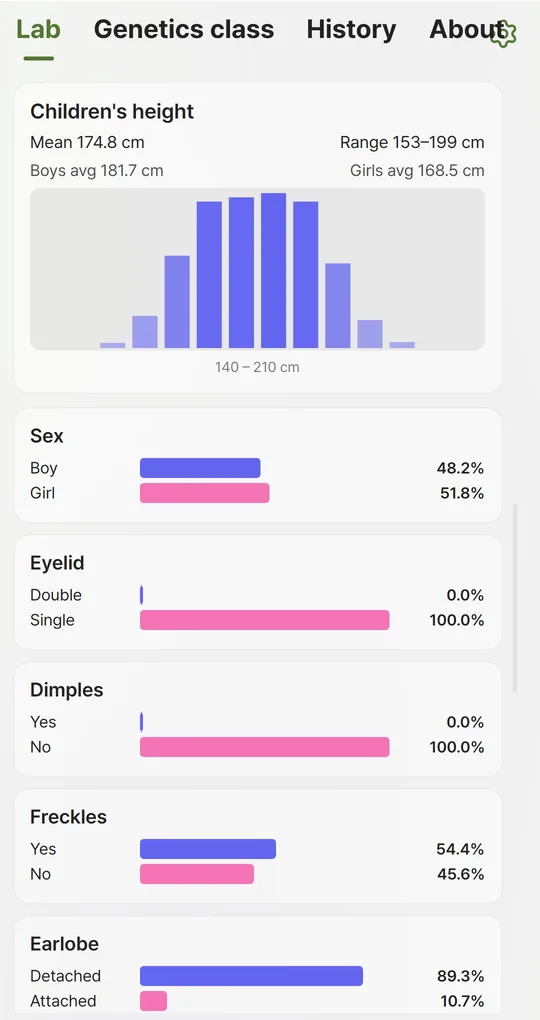
Pick eye colors and simulate
Choose each parent’s Eye color and tap Simulate 1,000 to see bars for all five colors. The further apart the parents’ colors, the wider the spread.
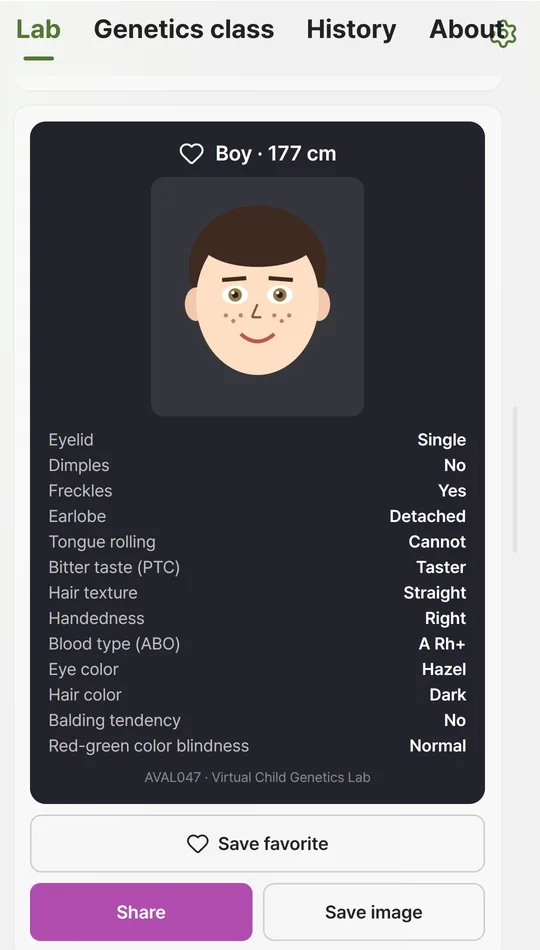
Meet one child at a time
Each tap on Draw one child gives a new virtual child with an eye color on the card, so you can see different colors from the same parents.
In the app, two “black” parents always give a black-eyed child. Real eye color is more varied, so treat the results as a game.
FAQ
Can two brown-eyed parents have a blue-eyed child?
Yes, depending on the combination of genes they carry. It is rare when both parents have very dark brown eyes.
Can eye color show who a child’s parents are?
No. Many genes are involved and exceptions are common, so it cannot be used that way.
Genetic Kids Lab - Child Trait Simulator
Pick the parents’ traits and see trait ratios across 1,000 virtual children. An educational, just-for-fun simulator that works offline. Free on Android.